Kronig-Penney Model
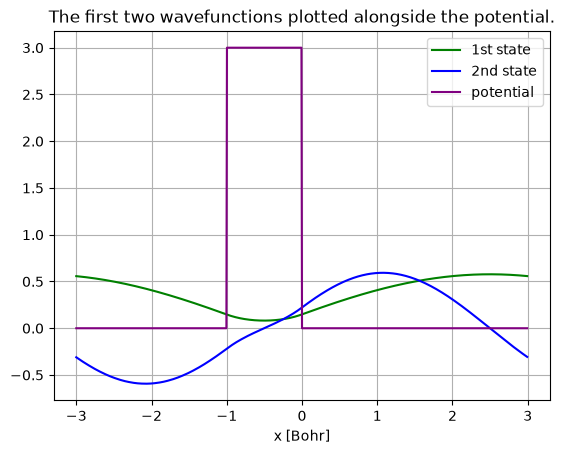
The Kronig-Penney model is a 1D system that demonstrates band gaps, which relate to the allowed energies for electrons in a material. In this tutorial we calculate the bandstructure for Kronig-Penney Model. The Kronig-Penney Model has a periodic potential of
Where b is the width of each barrier, and a is the spacing between them.
!mkdir 7-Kronig-Penney-Model
Input
The following input file will be used for the ground state calculation:
%%writefile 7-Kronig-Penney-Model/inp

stdout = 'stdout_gs.txt'
stderr = 'stderr_gs.txt'

CalculationMode = gs
ExtraStates = 4
PeriodicDimensions = 1
Dimensions = 1
TheoryLevel = independent_particles

a = 5
b = 1
V = 3

Lsize = (a + b)/2

%LatticeParameters
  a + b
%

Spacing = .0075

%Species
 "A" | species_user_defined | potential_formula | "(x>-b)*V*(x<0)" | valence | 1
%

%Coordinates
 "A" | 0 |
%

%KPointsGrid
 11 |
%

%KPointsPath
  11 |
 0.0 |
 0.5 |
%

ConvEigenError = true

%Output
 potential
 wfs
%
OutputFormat = axis_x
OutputWfsNumber = "1,2"
Writing 7-Kronig-Penney-Model/inp
!cd 7-Kronig-Penney-Model && octopus
from postopus import Run
import matplotlib.pyplot as plt

run = Run("7-Kronig-Penney-Model")
wf = run.scf.wf().isel(step=-1).real
v0 = run.scf.v0().isel(step=-1)

fig, ax = plt.subplots()

wf.sel(st=1, k=1).plot(ax=ax, label="1st state", color="green")
wf.sel(st=2, k=1).plot(ax=ax, label="2nd state", color="blue")
v0.plot(ax=ax, label="potential", color="purple")

ax.set_title("The first two wavefunctions plotted alongside the potential.")
ax.set_ylabel("")
ax.grid(True)
ax.legend();
Bandstructure
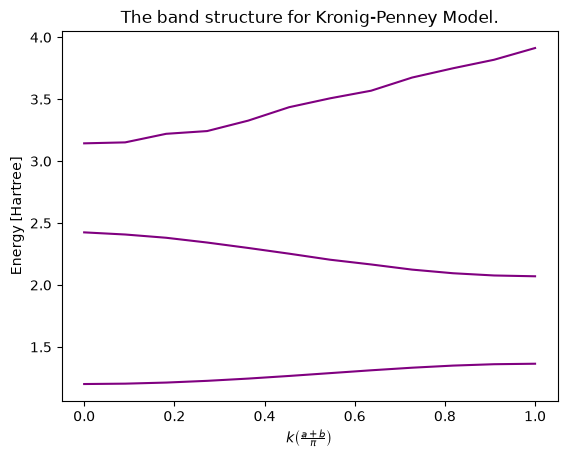
To calculate the bandstructure simply change the CalculationMode to unocc.
%%writefile 7-Kronig-Penney-Model/inp

stdout = 'stdout_unocc.txt'
stderr = 'stderr_unocc.txt'

CalculationMode = unocc
ExtraStates = 4
PeriodicDimensions = 1
Dimensions = 1
TheoryLevel = independent_particles

a = 5
b = 1
V = 3

Lsize = (a + b)/2

%LatticeParameters
 a + b
%

Spacing = .0075

%Species
 "A" | species_user_defined | potential_formula | "(x>-b)*V*(x<0)" | valence | 1
%

%Coordinates
 "A" | 0 |
%

%KPointsGrid
 11 |
%

%KPointsPath
 11 |
 0.0 |
 0.5 |
%

ConvEigenError = true
Overwriting 7-Kronig-Penney-Model/inp
!cd 7-Kronig-Penney-Model && octopus
To plot the bandstructure, we will use postopus.
run = Run("7-Kronig-Penney-Model")
run.scf.bandstructure()[["band_3", "band_4", "band_5"]].plot(
    color="purple", legend=False
)
plt.xlabel(r"$k \left(\frac{a+b}{\pi}\right)$")
plt.ylabel("Energy [Hartree]")
plt.title("The band structure for Kronig-Penney Model.");
References
Sidebottom DL. Fundamentals of condensed matter and crystalline physics: an introduction for students of physics and materials science. New York: Cambridge University Press; 2012.
Tutorial Validation Checks
import numpy as np
ev = run.scf.eigenvalues()
ev is a pandas Dataframe with the following indeces and columns:
ev.index
MultiIndex([( 1, 1),
            ( 1, 2),
            ( 1, 3),
            ( 1, 4),
            ( 1, 5),
            ( 2, 1),
            ( 2, 2),
            ( 2, 3),
            ( 2, 4),
            ( 2, 5),
            ...
            (22, 1),
            (22, 2),
            (22, 3),
            (22, 4),
            (22, 5),
            (23, 1),
            (23, 2),
            (23, 3),
            (23, 4),
            (23, 5)],
           names=['k', 'st'], length=115)
ev.columns
Index(['Spin', 'Eigenvalue', 'Occupation', 'Error'], dtype='str')
We can extract the eigenvalues for k-point i, by ev.Eigenvalue.loc[i].
np.testing.assert_allclose(ev.Eigenvalue.loc[1].to_numpy(),
                           [0.137751, 0.60848 , 1.200825, 2.426264, 3.127127], rtol=0.001)
np.testing.assert_allclose(ev.Eigenvalue.loc[2].to_numpy(),
                           [0.138834, 0.602898, 1.212622, 2.380146, 3.199639], rtol=0.001)
np.testing.assert_allclose(ev.Eigenvalue.loc[5].to_numpy(),
                           [0.141801, 0.588478, 1.244819, 2.297815, 3.348898], rtol=0.001)
np.testing.assert_allclose(ev.Eigenvalue.loc[10].to_numpy(),
                           [0.152085, 0.545918, 1.360813, 2.076682, 3.841202], rtol=0.001)
np.testing.assert_allclose(ev.Eigenvalue.loc[15].to_numpy(),
                           [0.140121, 0.596494, 1.226601, 2.342423, 3.242761], rtol=0.001)
np.testing.assert_allclose(ev.Eigenvalue.loc[20].to_numpy(),
                           [0.149705, 0.554934, 1.332629, 2.12374, 3.674789], rtol=0.001)